



 509 692

this journal and similar synopses in other journals are a step
in the right direction; however, educated patients want to
see what their doctor is reading.
Urology
[12_TD$DIFF]
as a field
[3_TD$DIFF]
prides itself on innovation, and
solutions to increased OA publishing are a shared
responsibility. Many OA journals have found ways to
rigorously review manuscripts and publish (albeit often
exclusively online) impactful research at fractions of
traditional publishing costs. Meanwhile, there is tension
between the growing costs of traditional journal subscrip-
tion fees, which limit access to those with privileges at
institutional library systems, and the increased portability
of information that pushes for —
[4_TD$DIFF]
even demands — open
access to information. Publishers rarely disclose operating
budgets, but independent estimates suggest
[3_TD$DIFF]
large pub-
lishing houses return profit margins of 20–50%
[8]. If true,
the onus of finding creative ways to offset publication
costs and other obstacles to OA should not fall solely on
authors.
For authors, APCs in the range of $3000–5000 are not
conducive to sustained publication in OA formats. To
mitigate these costs, we recommend
[3_TD$DIFF]
funded researchers
build APCs into their grant applications. For unfunded or
minimally funded work, we recommend
[3_TD$DIFF]
authors consider
three paths to more cost-effective OA publishing:
(1) Apply for reduced or waived APCs, which many journals
offer on a case-by-case basis.
(2) Take advantage of the ‘‘green’’ OA options. Green OA
usually involves uploading a submitted or accepted
manuscript to article repositories or uploading a
published manuscript after a publisher-specific embar-
go period. SHERPA
( www.sherpa.ac.uk )can help authors
[5_TD$DIFF]
understand publisher-specific green OA options. SERPA
and OPENDOAR
( http://www.opendoar.org) provide
directories to help authors locate appropriate reposi-
tories.
ResearchGate.netallows authors to freely
share versions of their manuscript with international
colleagues.
(3) Consider submitting manuscripts directly to OA jour-
nals, which generally have lower APCs than hybrid
journals.
The growth of social media, increasing portability of
information, and the expanding body of quality OA
literature forces the inevitability of open science. With
time, the gravity of greater influence and portability
inherent to OA will pull authors to OA formats. The most
impactful journals will be those renovating their publishing
paradigm to meet authors at the center of the pursuit for
open science. In the process, individual authors will gain
[(Fig._1)TD$FIG]
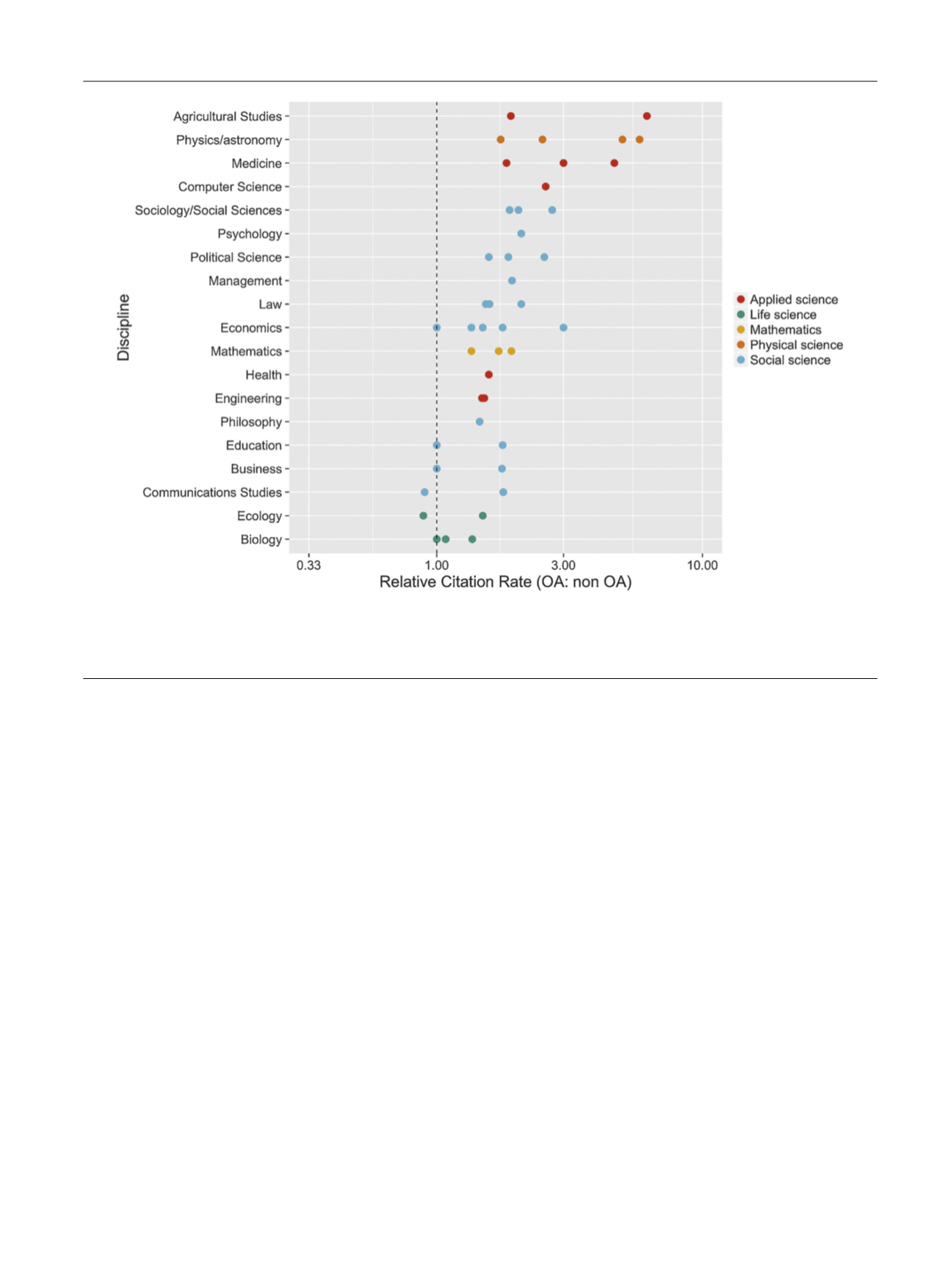
Fig. 1 – Open access articles get more citations
[2]. The relative citation rate of open access (OA) to non-OA articles in 19 fields of research. This rate is
defined as the mean citation rate for OA articles divided by the mean citation rate for non-OA articles. Multiple points for the same discipline indicate
different estimates from the same study, or estimates from several studies. Figure and legend
[6_TD$DIFF]
without changes from McKiernan et al. How open
science helps researchers succeed. Elife 2016;5e16800
[2] .E U R O P E A N U R O L O G Y 7 1 ( 2 0 1 7 ) 5 0 8 – 5 1 0
509